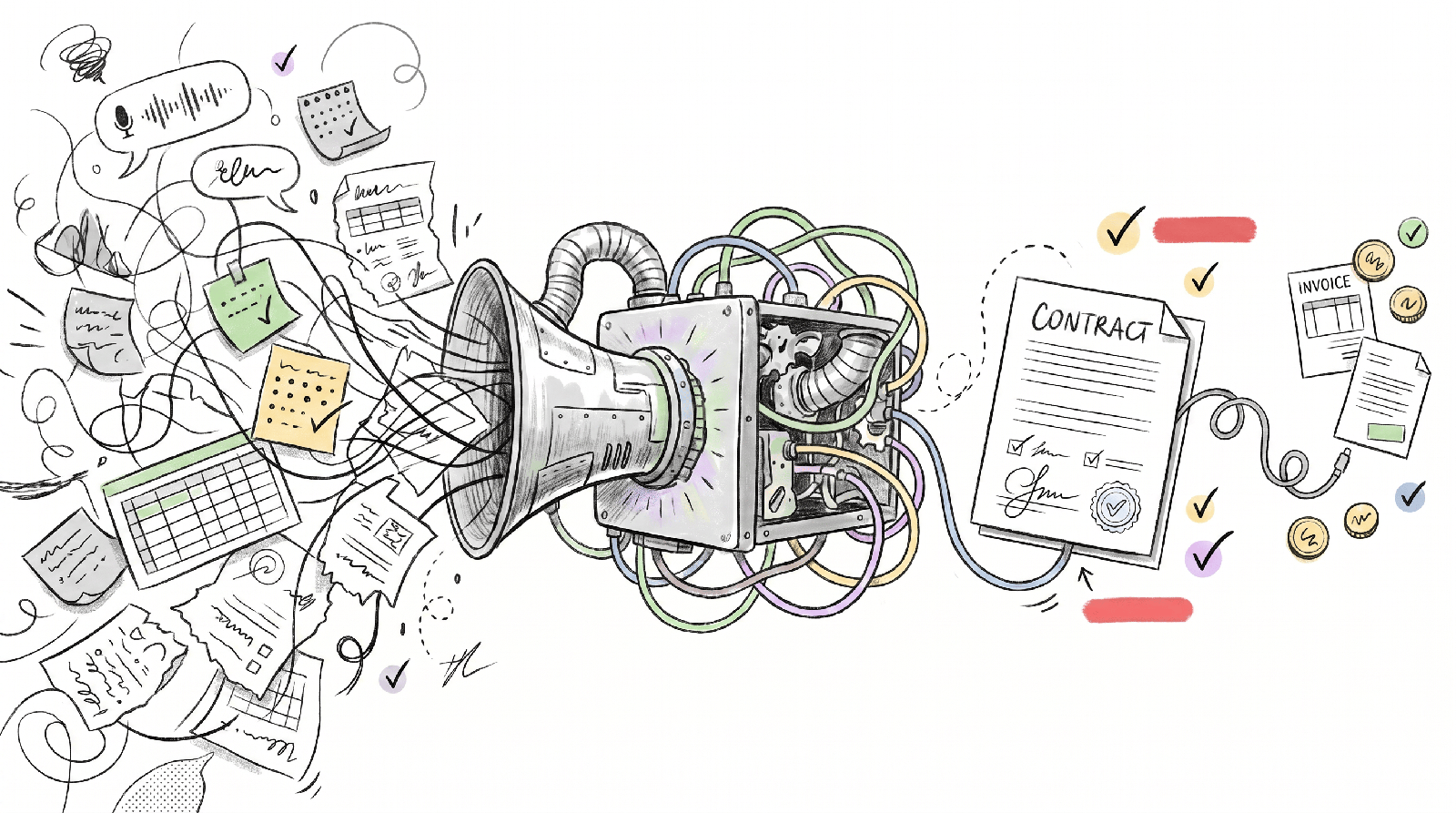
What Is Business Process Automation? A Practical Guide for Teams Drowning in Manual Work
Share this article


Table of Contents


You already know what business process automation is in theory. The real question is why your team still spends so much time on work that shouldn’t require a human in the first place.
Every organization has them: the repetitive handoffs, the copy-paste reporting, the approval chains that exist because someone set them up years ago and nobody’s questioned them since.
Let’s talk about how to get your team out of the cycles and into business process automation that closes the gap AKA the space between how work should flow and how it actually flows.
What a Workflow Actually Is (and Isn’t)
A workflow is the sequence of steps required to complete a recurring task: who does what, in what order, using which tools, and what happens when something goes wrong.
The problem: most workflows were never designed. They evolved. Someone started tracking projects in a spreadsheet, someone else added an email approval step, a third person built a dashboard pulling from a different source. That’s not a workflow. That’s institutional memory held together with duct tape.
The Three Criteria for What to Automate First
If you’re exploring automation in workflows, remember, not everything should be automated. The best process automation tools target work that meets three conditions:
- It’s repetitive: the same steps, the same sequence, multiple times per week or month
- It follows predictable logic: if X, then Y
- It currently requires a human to do something a machine could handle: data entry, status updates, report assembly, document routing
If a task checks all three boxes, it’s costing you more than you think. Task automation software exists specifically for this work, not to replace people, but to stop burning their time on things that don’t require their expertise.
A Starter Framework: Your First Automation in 5 Steps
The biggest mistake teams make is trying to automate everything at once. Start here:
- Pick one workflow. Choose something painful, manual, and high-frequency. Monthly reporting, data consolidation, and approval routing are common starting points.
- Map the current state. Document every step, every handoff, every tool involved. You'll almost always find steps that exist for no reason. This is where most teams realize the problem isn't the tools, it's the process itself.
- Identify the automatable steps. Apply the three criteria from earlier in this guide. Not every step needs automation, just the ones where humans are doing machine work.
- Build and test. This is where many teams stall. No-code tools are powerful, but building a reliable workflow that handles edge cases takes more than dragging and dropping a few connectors. Teams that move fastest here typically work with a dedicated automation partner, like us. This isn’t because the tools are hard, but because designing a workflow that holds up under real conditions requires operational experience, not just technical setup.
- Measure and expand. Track time saved, error reduction, and throughput. Ace Workflow clients typically see enough ROI from the first automated workflow to build the internal case for the next one within weeks. That momentum matters. The advantages of business process automation compound over time, but only if the first win is convincing enough to keep going.
The framework above works whether you're automating with simple no-code tools or building AI-powered workflows. But if you're evaluating automation in 2026, you need to understand how AI, specifically Agentic AI, has changed what's possible.
Where AI Fits Into Business Process Automation and Why "Agentic" Changes the Equation
If you've been paying attention to the automation space over the past year, you've noticed the conversation has shifted from "AI-assisted" to "agentic AI." That distinction is worth understanding before you invest in any automation initiative.
Traditional workflow automation follows rigid if-this-then-that logic. A form gets submitted, a notification fires, a row gets added to a spreadsheet. It works perfectly, until something doesn't match the expected input. An invoice with a missing field. A support ticket that doesn't fit a clean category. A lead that needs routing based on context that lives across three different systems. That's where traditional automation breaks, and that's exactly where agentic AI picks up.
What agentic AI actually does differently
An agentic AI workflow combines the reliability of structured automation with AI that can reason through variable conditions. Instead of following a fixed script, an AI agent can assess a goal, decide what step to take next, use tools across multiple systems, check the result, and keep going, or escalate to a human when the situation genuinely requires judgment.
In practical terms, this looks like an AI agent that monitors incoming support tickets, categorizes them based on free-text descriptions rather than dropdown menus, pulls relevant customer history from your CRM, drafts a response using your team's voice and tone, and routes edge cases to the right person — all without someone manually triaging every message. Or a sales workflow where an AI agent researches prospects before every call by scanning your CRM, email history, and public data, then surfaces a briefing so your rep walks in prepared instead of spending 20 minutes doing manual research.
These aren't hypothetical. A 2025 PwC survey found that 79% of organizations are already running AI agents in production, with 66% reporting measurable productivity gains. Organizations that have deployed AI workflow automation are projecting an average ROI of 171%, with finance and procurement workflows reporting cost reductions as high as 70%.
Where most teams go wrong with AI automation
The biggest mistake we see is what Deloitte calls "agent washing" — layering AI agents onto existing processes without reimagining how the work should actually be done. Bolting an AI tool onto a broken workflow just gives you a faster broken workflow. Some organizations have found that poorly designed agentic implementations actually add work to a process rather than removing it.
This is the gap Ace Workflow exists to close. We don't hand you an AI tool and wish you luck. We map your actual operations: the handoffs, the exceptions, the workarounds your team has built over the years and design agentic automations that account for the messy reality of how work flows through your organization. Our approach combines consulting expertise, no-code development, and agentic AI through our proprietary platform to give you systems that eliminate manual chaos rather than reorganize it.
What this means for your team right now
AI-powered automation has moved from experimental to operational. The question isn't whether agentic AI works, it's whether you're going to redesign your workflows around it or keep paying $200K employees to do $20/hr tasks while your competitors pull ahead. The teams getting the best results in 2026 are the ones treating AI as a reason to rethink how work gets done, not just a faster way to do what they've always done.
If you're not sure where AI fits into your current operations, that's exactly what our free agentic AI consultation is designed to answer.
So Where Do You Start?
The advantages of business process automation compound over time. But they only compound if you start. Every week you wait is another week your team spends on work that doesn't need them: another week of $200K people buried in $20/hr tasks. Digital business process automation isn't a one-time project. It's the decision that manual work is a choice, not an inevitability. Your team deserves systems that actually work. Start with one workflow. Prove the ROI. Then keep going.
Ready to find out where automation fits in your operations? Book a free agentic AI consultation with Ace Workflow.
Related posts